
Nomaj — Concept References
A linked list to save me when I'm losing an argument…
261028
Time on Task
I had observed as a classroom teacher, mostly as a high school math teacher, that people differed considerably in their motivation and it struck me that what people accomplish in life is very much a product of the quality and quantity of time on task.
That was an intuition that only sharpened in the first half of my career, and I continue to believe that the quality and quantity of time on task is what gets you up any learning curve for anything. You want to play tennis better, you want to be better at chess, you want to be better public speaker, a better parent, a better citizen… it's a learning curve.
How much time are you going to spend and what's the quality of that time?
—Angela Duckworth on Econtalk
261027
HOOP: Hatred of Others’ Profits
William D. Nordhaus conducted research on the topic:
Only a miniscule fraction of the social returns from technological advances over the 1948-2001 period was captured by producers, indicating that most of the benefits of technological change are passed on to consumers rather than captured by producers.
Arnold Kling continues:
Profits often reflect a contribution to overall welfare. Profits are earned within a positive-sum game for society. Profits induce firms to serve consumers and to innovate. Losses force inefficient and outmoded businesses to adapt or shut down.
HOOP is the opposite point of view. It regards profits as something that businesses take from the rest of us, as if we can take innovation and efficiency for granted. HOOP acts as if we are in a zero-sum environment in which one person’s gain is necessarily another person’s loss.
tags: #capitalism #class-struggle #profit
261014
Cassette Futurism
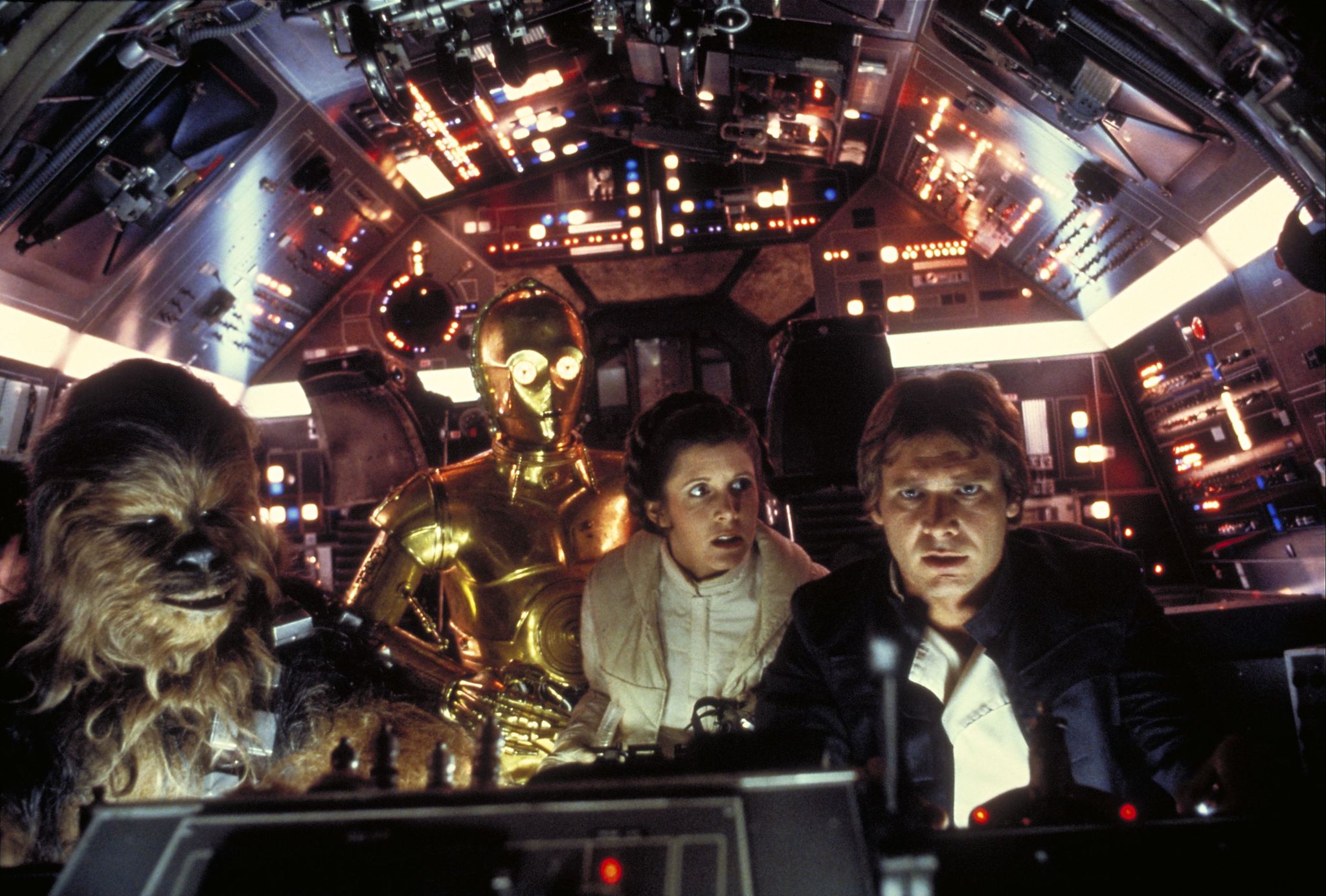
Cassette Futurism is a visual aesthetic that, instead of being traditionally futuristic, uses imagery based on 70's gadgets.
What I appreciated about discovering this term it is that I suddenly got the Star Wars, Blade Runner etc. aesthetic — oh yeah, that's what it is!
Imagine futuristic space travel, but data is stored on cassette tapes, locks are secured via punch card, the flight computer is analog, blinking buttons in abundance, and if something is broken, you can open it, solder it back together, or put some tape on it.
The quintessential example is Star Wars — here's the cockpit of the Millenium Falcon (source):
An old ghetto blaster would fit right in (source):
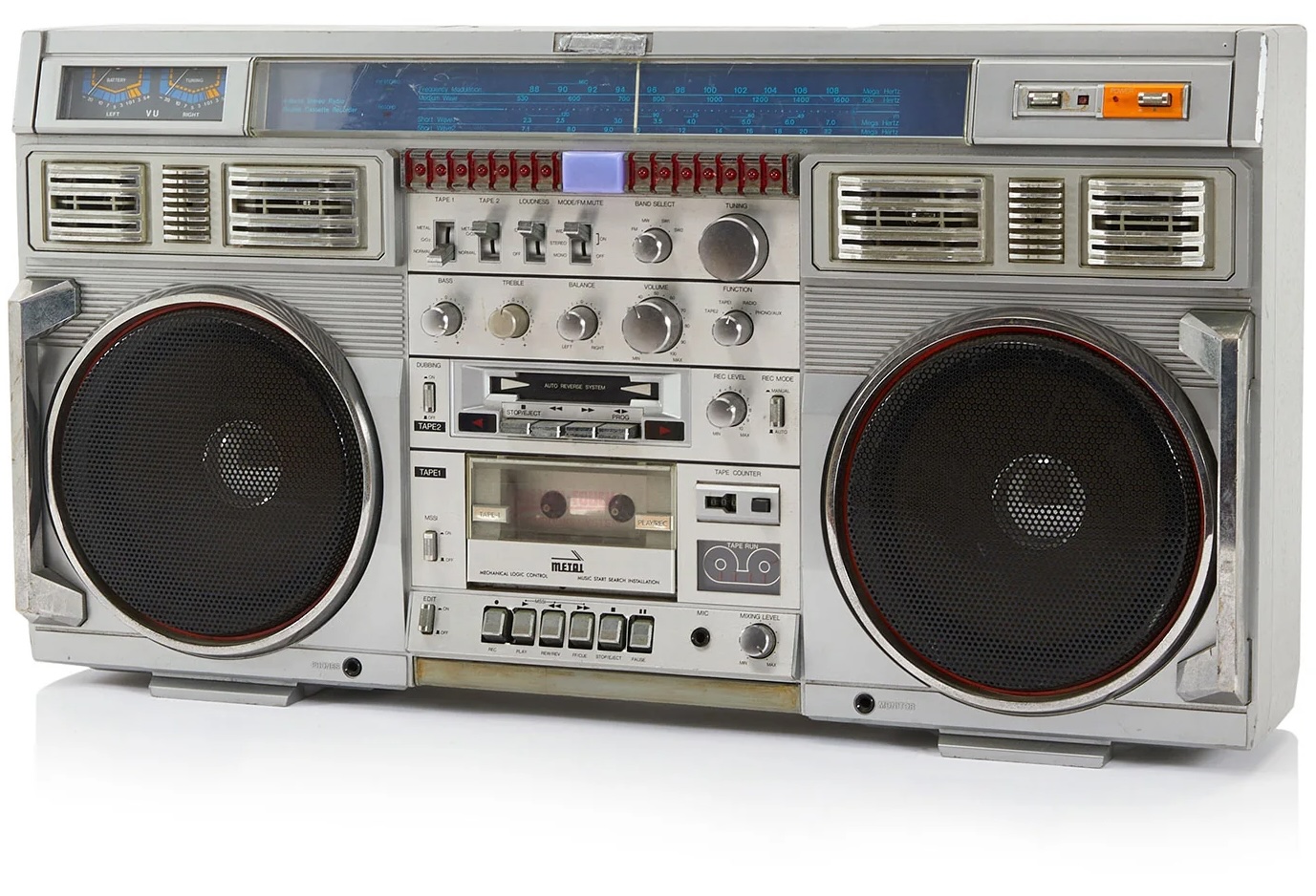
But, I'm not completely sure which way the arrow of causality runs… Star Wars had a massive effect on industrial design — could it be that the ghetto blasters were just imitating Star Wars?
tags: #aesthetic #sci-fi
261013
From a Texas Grocery Store to the End of the Cold War
The United States was the first country future Russian President Boris Yeltsin ever visited outside the Soviet Union on his own.
He had been dined by wealthy Americans before, flown on their private jets, and socialized with the wealthy.
The 1989 trip took him all over the country, and one of the stops was a grocery store in Webster Texas. His visit lasted only 20 minutes.
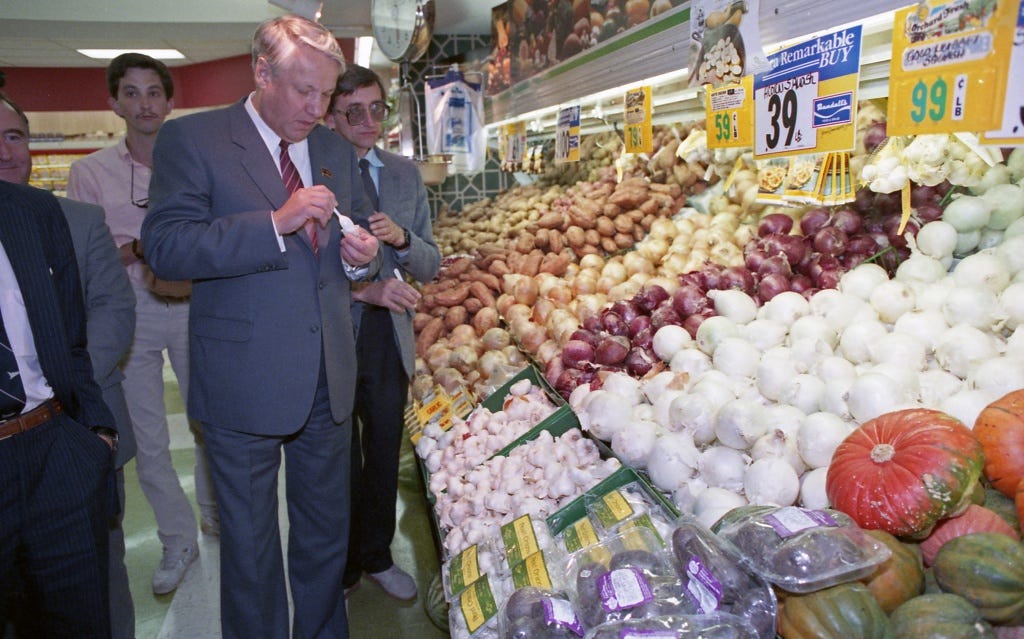
Afterwards, he was in such a state of shock that he was speechless on the plane ride back.
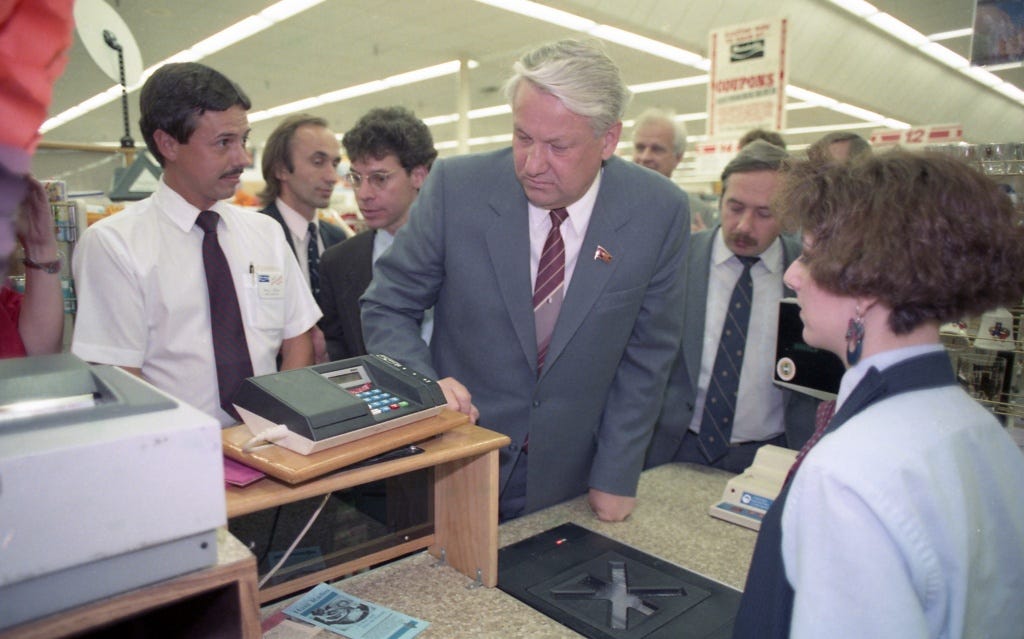
Yeltsin reportedly told aides after a long pause that, if Soviet citizens saw what he had seen, there would be a revolution.
In this Texas store, far away from any urban center, more than 30,000 items were fully stocked. Not even the Soviet Politburo had that many options available.
Yeltsin was stunned: “Does this cornucopia exist every day for everyone?!”
His experience as party secretary consisted of struggling to procure food supplies for Sverdlovsk, Russia. He had also organized poultry farms — but all of it seemed insignificant after seeing this small, well-stocked shop.
Upon returning back to the Soviet Union, [Yeltsin] spoke to journalists about his experience.
He spoke of the “madness of colors, boxes, packs, sausages, and cheeses.”
He relayed to his aides that Americans spent just a tenth of their income on food, for more variety, whereas Soviet citizens spent over half.
Thereafter, he decided that his mission was to bring this American dream to the Russian people.
tags: #capitalism #communism
261012
A Side Benefit of Capitalism
I don't know a lot about Fukuyama, except that apparently he is both wrong and overrated.
However, his idea intrigues me: throughout history, people with intense megalothymia have became tyrants, conquerors, or generals, seeking dominance through politics and war.
Fukuyama argues that free-market economies act as a vital safety valve for society. By allowing highly ambitious and hungry-for-recognition individuals to channel their aggression into corporate supremacy, liberal democracies can successfully divert them away from politics.
But, it doesn't always work:
I actually referred to Donald Trump in my original End of History and the Last Man, when I said that one of the great advantages of living in a capitalist democracy is that it gives you an outlet for megalothymia — for the desire to be recognized as better than other people — in the economy.
You could get very, very rich, and that would bleed off some of the ambition and energy that might otherwise go into politics.
Little did I realize that, more than thirty years later, that wouldn’t be enough for Donald Trump.
So it’s not a guarantee that you won’t have destabilized democratic politics as a result of that kind of outsized ambition.
I think Fukuyama was mostly right, but he didn't count on Obama pushing Trump to run for president (it's really true!).
via Scott Sumner